
The Course Production Unit supports the design, development, production, and delivery of high-quality digital and blended courses.
Working collaboratively with academic teams, the unit provides structured learning design, media production, course build, and quality assurance services to ensure courses are pedagogically sound, technically robust, and learner-centred.
Who we support
Course convenors, programme leads, and academic teams developing or redesigning learning for digital, blended, or fully online delivery.
What we do
We translate academic intent into a coherent learning experience, combining learning design, production, and quality assurance with a clear build and handover process.
How we work
We co-design with your team, clarify roles early, and use structured review cycles to support efficient production and consistent quality.

What we offer
Course Design and Development
- Design and development for short courses, PGDips, and MOOCs, as well as bespoke requests
- Learning design and course mapping
- Learner activity and assessment design aligned to learning outcomes
Content Development Support
- Content development guidance, editing support, and production preparation
- Scripting and storyboarding support for video and multimedia
Advice on multimodal content design aligned to Universal Design for Learning principles
Media Production and Digital Design
- Digital media production (video recording, editing, and post-production)
- Graphics and visual assets (diagrams, templates, learning visuals)
- Animation (where appropriate, scoped as part of the project)
Platform Build and Quality Assurance
- LMS course build and learner pathway design
- Quality assurance checklists and structured reviews
- Optional final LMS course review prior to launch
Examples and Related Work
The One Button Studio (OBS) serves as the entry point to CILT’s integrated Studio Ecosystem, offering a simple, self-service solution for rapid video creation with minimal setup and technical support. Complementing this, the ecosystem includes a professional video podcast studio and a customisable high-end production studio, enabling a full spectrum of production capabilities from quick recordings to complex, multi-camera outputs. Through standardised workflows, continuous innovation in tools and practices, and the support of dedicated technical and production staff, the studios ensure consistent, high-quality content across formats, including video and audio podcasts. Together, this multi-studio environment provides a flexible, scalable solution that translates diverse academic needs into effective, future-focused digital learning experiences.
Digital Design Team services
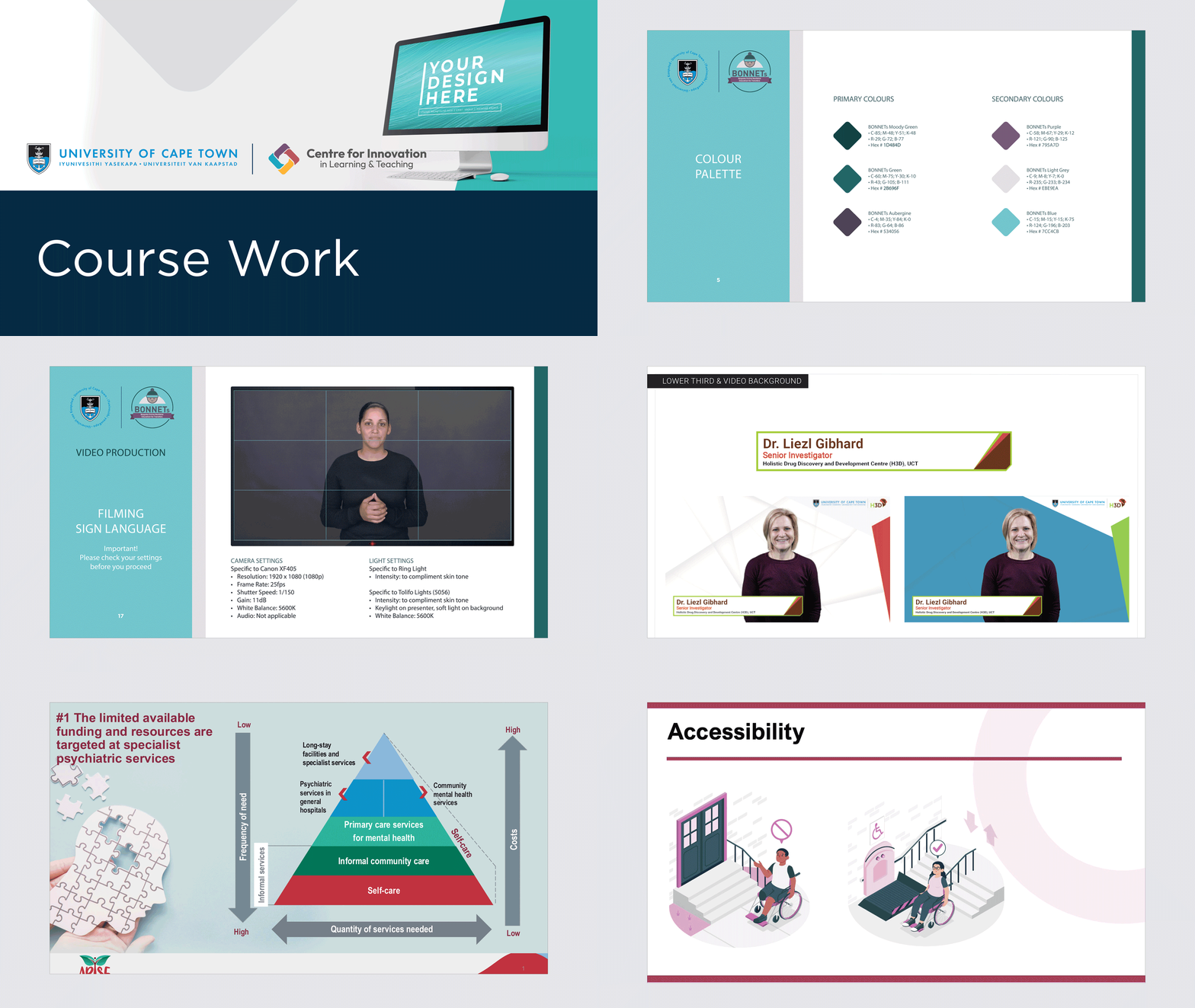
The Digital Design Team (DDT) functions as a shared service within CILT, translating pedagogical intent into effective digitally designed experiences. Through standardised workflows and AI-supported production, the team delivers inclusive, representative, and technically robust designed content, across initiatives ranging from UCT courses to global open-learning platforms.
Course Production Process
Design and planning
Design is the foundation of course creation. CILT learning designers work with the academic team to co-create a course map and module plans that define learning outcomes, learner activities, assessments, and content requirements. This phase also establishes timelines and production schedules and promotes the use of multiple content modes aligned with Universal Design for Learning principles.
Content development
Based on the agreed course map, content is prepared for production. This includes lesson planning, assessment development, content collation, scripting for videos, and preparation of visual elements such as graphics and diagrams. Academics develop subject-matter content, while CILT provides guidance, quality assurance, and production preparation support.
Media production
Once content is ready, production begins. CILT’s Digital Media Unit and Digital Design Team manage the technical production workload, including video recording, editing, graphic design, and animation. Two review cycles per video are included, with additional edits costed separately.
Course site build
CILT builds the course on the selected learning management system, designing the learner pathway, loading content, and integrating assessments and instructional text. After launch, responsibility for future amendments shifts to the academic team.
Quality assurance and review
CILT supports quality assurance through structured checklists, learning design reviews, and optional final LMS course reviews. Academics are responsible for content accuracy and subject-matter quality checks prior to publication.
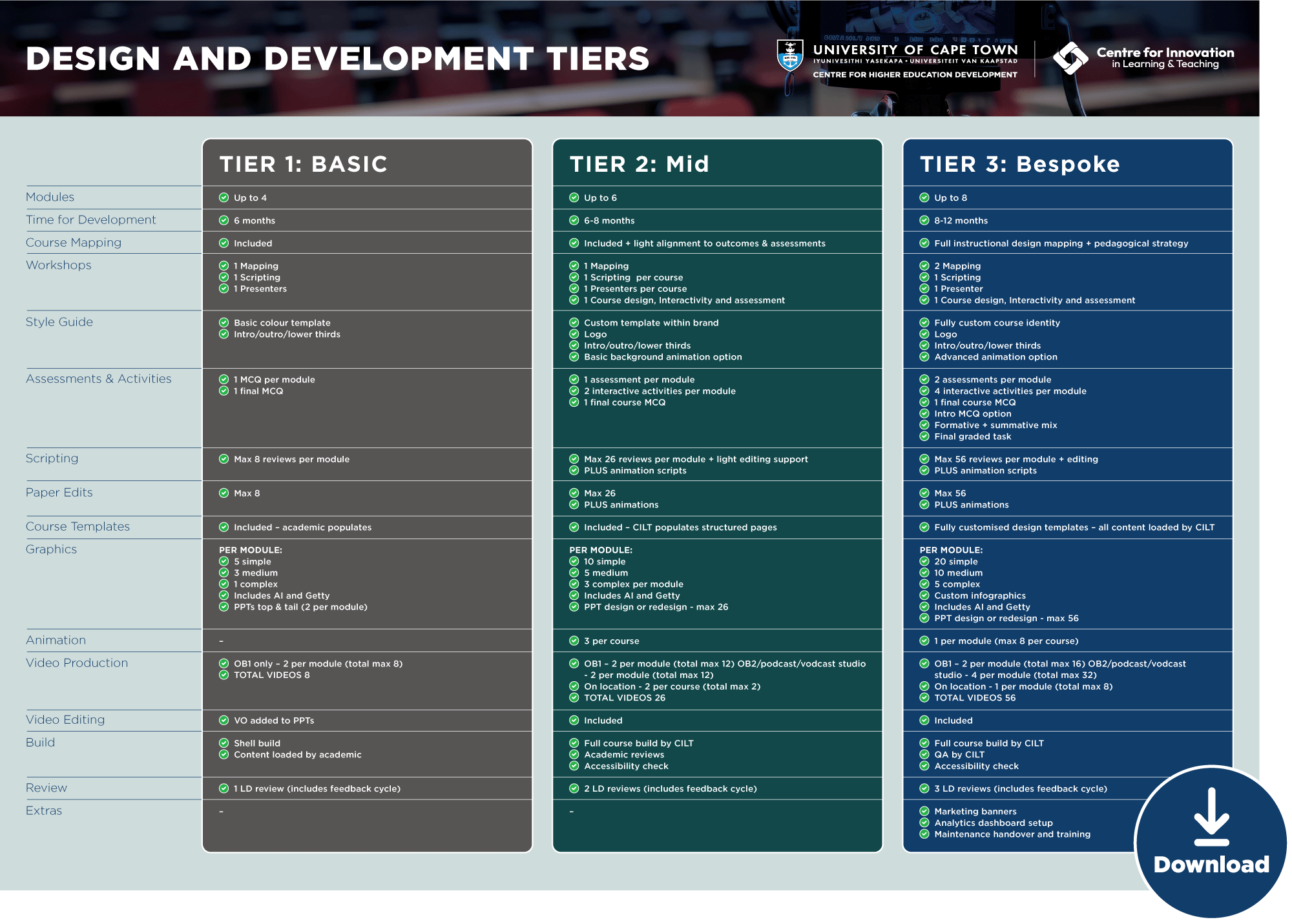
Design and Development Tiers
CILT offers three tiers of service to accommodate different levels of complexity, scale, and customisation.
Tier 1: BasicSuitable for smaller courses with limited media complexity and a shorter development timeline. Includes foundational learning design, basic templates, limited assessments, and essential media production. | Tier 2: MidDesigned for more developed courses requiring greater interactivity, stronger alignment to outcomes, and a broader mix of media formats. Includes enhanced learning design input, increased assessments and activities, and expanded media production options. | Tier 3: BespokeA fully customised offering for complex, high-impact courses. Includes comprehensive instructional design, advanced media and animation, fully customised templates, extensive assessments, and enhanced analytics and handover support. |
Cost Structure
Each tier is costed according to scope, duration, and production complexity.
Contact Catherine Robb for pricing.
Kindly note:
• Final costs may vary due to additional requirements or specialist services requested.
• Course convenors, HoDs and/or Deputy Deans will be required to sign a Memorandum of Understanding before the work commences.
• The MoU includes agreed deliverables, timeline and budget.

Roles and Responsibilities
| Academic Team | CILT Production Team | |
|---|---|---|
| Initial learning design | Work with the CILT team to develop a map for each course from which it will be developed. | Work with the academic team to develop a map for each course from which it will be developed. |
| Course design | Create a lesson plan (weekly doc) per module within each course providing all relevant information that will be transferred onto the LMS during course build. | Review the lesson plans. |
| Learning design consultation | Consider recommendations from CILT and reach an agreement for going forward. | Make recommendations of the technology to be used based on the pedagogical requirements, skills and budget available. |
| Scripting | Write scripts and send them to the CILT team for QA in a timely manner. | QA scripts and provide feedback. |
| Filming | Agree to a filming schedule and arrive punctually, having rehearsed scripts. | Record video lectures and provide QA on the fly. Follow script during filming and pick up on mistakes/request do-overs. |
| Graphic design | Approve the style guide. Brief in graphics (only pedagogically appropriate graphics will be considered). Approve PPT slides before recording commences. QA graphics. | Develop a style guide for videos and graphics. Design the content of the PPT slides when necessary. Develop, rework or commission graphics. |
| Paper edits | Review paper edit. | Provide a brief for each script showing where graphics should appear on screen and for how long. QA paper edits where applicable (includes the script review). |
| Video editing | n/a | Edit videos according to paper edits signed off by the academic team. |
| Quality assurance | QA all assets produced from a content perspective. | QA all assets produced from a production perspective. |
| Course build | QA all modules and courses from a lesson plan perspective. | Build courses on the relevant LMS. |
| Supplementary materials and activities | Develop supplementary materials and activities. | Make recommendations based on the pedagogical needs articulated by the academic team. |
| Project management | Adhere to the project plan; manage contributors to meet project timelines. | Manage the project timelines and resources along with budget regarding the CILT internal team and external service providers. |

Getting started
Departments and partners are encouraged to contact CILT early to discuss scope, timelines, and the most appropriate tier of support. Early engagement helps ensure realistic planning, efficient production, and high-quality learning experiences.
Please contact catherine.robb@uct.ac.za or fill in this online form and we will contact you.
Important to note:
- Best for: UCT course teams developing or refreshing digital and blended provision
- Course types: Short courses, PGDips, MOOCs, and micro-credential courses
- What you receive: A structured course map, produced media assets, an LMS-ready course site, and quality assurance support
How work is confirmed: A signed Memorandum of Understanding (MoU) with agreed deliverables, timelines, and budget.
Before you request (required):
- You are a UCT staff member (or a faculty/departmental project partner working through UCT);
- You have departmental approval (Course Convenor and HoD and/or Deputy Dean, as appropriate);
- Accreditation processes are in place where required (for example, IPD processes for formal offerings); and
You have a confirmed budget (or are able to scope costs for approval).